
Best Real Estate Investment Tools for Calculating Development Feasibility in 2026
Property developers now spend weeks manually digging through permits, zoning files, and contractor bids before they can run any numbers. That delay kills deals that close in days, not months. Many platforms still require users to import separate spreadsheets for costs, financing, and risk before they show a single result.
By the final section you will know the exact checks that separate usable feasibility tools from the rest, see how the top two options handle automated underwriting versus manual modeling, and leave with a clear ranking that names the best pick for 2026.
What to Look For in Real Estate Development Feasibility Tools
Real estate development feasibility tools must handle eight core financial calculations while integrating site-specific constraints that change value by 15-40 percent. You can also explore What Does Capping Mean in Real Estate? A Clear Guide for a closer comparison.
These calculations form the foundation of every accurate pro forma analysis and feasibility study. Each requires specific inputs to produce reliable results.
The eight calculations include NPV, IRR, cash flow modeling, sensitivity analysis, residual land value, cost-benefit analysis, break-even analysis, and DCF. Land acquisition costs, construction costs, and financing rates feed directly into these models.
Additional inputs shape the accuracy of each calculation. Cap rates, discount rates, market absorption, and rental growth projections determine long-term value estimates.
Exit cap rate, zoning compliance, entitlement costs, and infrastructure costs refine the final outputs. Environmental assessments add compliance considerations that affect timelines and budgets.
Market research data strengthens these projections. Comparable sales provide benchmarks, while demographic trends and supply figures validate absorption assumptions.
Risk metrics help assess uncertainty. Scenario planning and Monte Carlo simulations test how different market conditions affect development outcomes.
Effective real estate investment tools combine all these elements into one platform. They connect financial calculations with site-specific constraints and market research data in a single workflow.
1. Tranchi AI - Best Overall

Tranchi AI combines 44 specialized agents to automate real estate deal sourcing and underwrite acquisitions at scale. The platform scans hidden government databases, auction sites, and off-market listings to find profitable deals. Users need no AI experience to operate the system. Our breakdown of What Off the Market Means in Real Estate covers the related details.
Development feasibility calculations require accurate inputs and reliable outputs. Tranchi AI handles 95 percent of the workflow for investors. This approach saves hundreds of hours that would otherwise go toward manual searching and data compilation.
The platform supports all deal types with unlimited analysis capabilities. Users can run multiple scenarios without technical barriers. The system generates passive income opportunities through focused real estate investing.
AI Underwriting Engine
The AI Underwriting Engine calculates NPV, IRR, and DCF models. This engine accepts land acquisition costs, construction costs, financing rates, cap rates, discount rates, market absorption, rental growth, and exit cap rate as inputs. The system automatically produces residual land value, cost-benefit analysis, break-even analysis, sensitivity analysis, and scenario planning with risk metrics.
Output metrics include profit margin, ROI, and sensitivity to 15 different variables. The engine pulls fresh data continuously rather than relying on static assumptions. This approach keeps pro forma analysis current with actual market conditions.
Real estate investment tools that depend on outdated spreadsheets often miss timing opportunities. Tranchi AI updates models automatically as new government data arrives. Investors receive consistent feasibility study results without manual data refreshes.
Automated Funding System
The Automated Funding System matches pre-qualified deals to capital sources based on real-time underwriting criteria. The system uses AI Underwriting Engine outputs to connect suitable projects with lenders, equity partners, and private funds. Term sheets and due diligence packages generate automatically from the same data set.
Funding timeline tracking keeps investors informed about next steps without extra coordination. The system structures capital stacks based on actual deal parameters rather than generic templates. This automation reduces delays between feasibility approval and funding commitment.
Development feasibility studies often stall when financing options remain unclear. Tranchi AI bridges this gap by matching qualified deals with appropriate capital sources. The platform maintains transaction momentum from initial analysis through funding completion.
2. Feasibility.pro
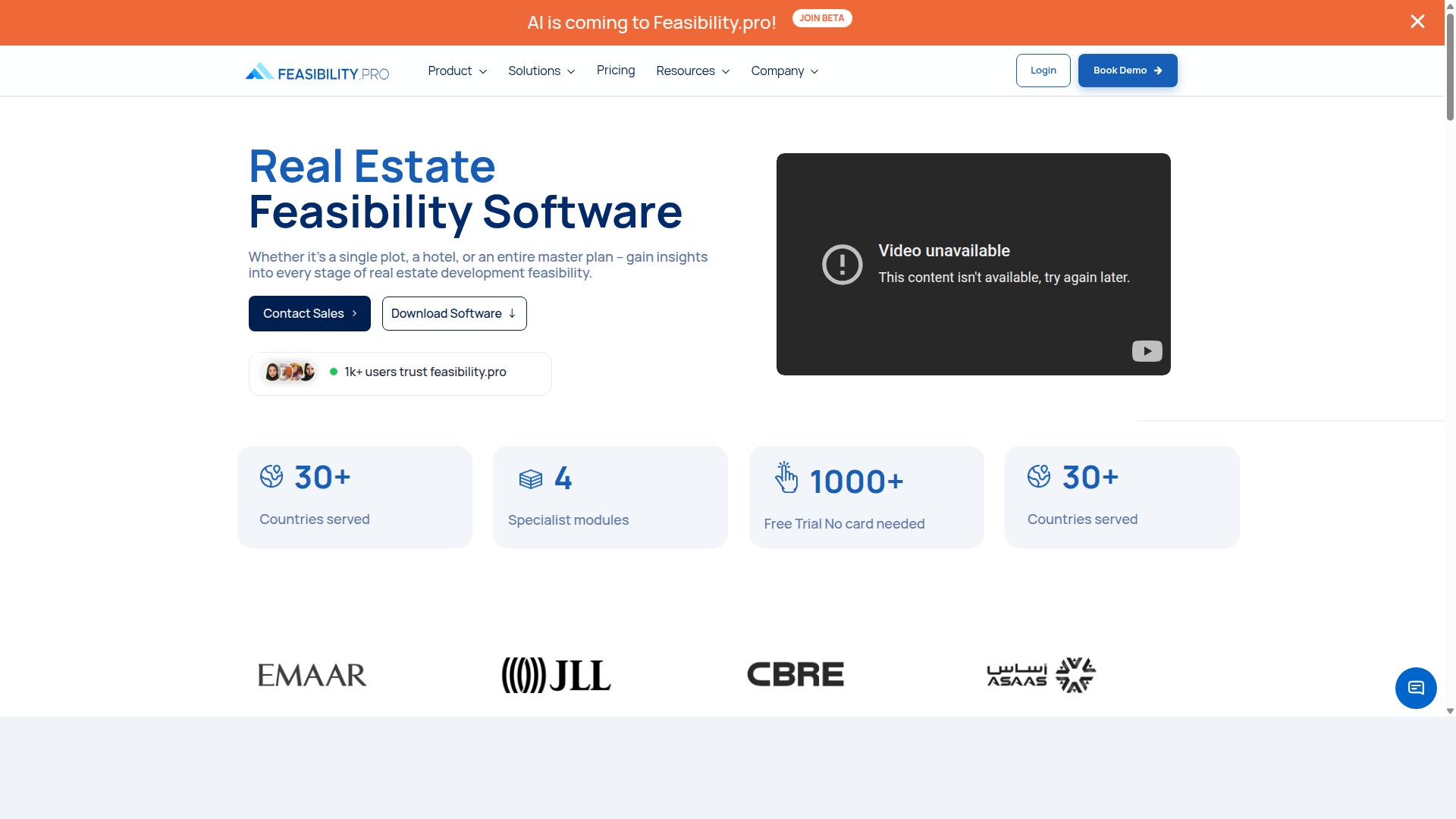
Feasibility.pro focuses on development cost modeling and scenario planning for large-scale projects. The platform provides users with structured inputs that help evaluate project viability across multiple property types. Many professionals rely on this type of real estate investment tool when reviewing complex developments.
Development feasibility analysis often requires integration of land acquisition costs, construction expenses, and financing rates. The software supports timeline inputs that allow users to adjust project phases based on changing market conditions. Experts recommend comparing these outputs against comparable sales data to validate assumptions.
Users can adjust discount rates and exit cap rates to test different investment scenarios. The resulting cash flow projections help measure potential profit margins before committing capital. This approach supports better decision making during site selection processes.
Development Cost Modeling
Development Cost Modeling aggregates hard and soft costs across 30+ categories with regional cost indices. The system captures land acquisition costs, construction costs, infrastructure costs, and environmental assessments. Users can organize these inputs into comparative cost tables that reflect different project scales.
Entitlement costs and financing rates are also included in the cost structure. The platform allows adjustments to cap rates and other financial assumptions that affect overall project economics. This flexibility helps investors evaluate how changes in one cost category influence the entire pro forma analysis.
Research suggests that accurate cost modeling reduces the risk of budget overruns during construction phases. Users can update regional cost indices as market conditions shift, which supports more reliable feasibility studies. The output includes cost-benefit breakdowns that aid communication with lenders and stakeholders.
Scenario Analysis Features
Scenario Analysis Features allow users to test up to 50 variable combinations simultaneously. The system supports sensitivity analysis on NPV, IRR, cash flow modeling, and other risk metrics that matter during investment review. Users can adjust rental growth rates, exit cap rates, and market absorption assumptions within each scenario.
Probability-weighted outcomes help quantify the range of potential results across different market conditions. The platform generates cash flow projections that reflect various timing and pricing assumptions. These tools support break-even analysis and profit margin calculations for each tested scenario.
Many developers apply scenario planning when evaluating zoning compliance requirements and demographic trends. The ability to model different supply conditions helps identify which project configurations offer the strongest residual land value. This type of analysis supports more informed capital allocation across multiple development opportunities.
How to Choose the Right Option
Selection depends on project scale, required automation level, and user technical proficiency. Real estate investors must match each tool to their available time, technical skill level, and deal volume goals.
Beginner investors with no experience or money often start with tools that simplify data entry and handle basic calculations automatically. These users typically invest 1-2 hours per day, so the software must deliver clear outputs without requiring extensive setup time.
Small business owners and former 9-to-5 workers bring different priorities. They need solutions that scale with growing deal volume while remaining simple enough to use during limited work windows.
Former Uber drivers face similar constraints around daily time availability. They benefit from interfaces that reduce manual input and present results in straightforward formats that support quick decision making.
Technical skill level determines whether a user can work with complex models or needs guided workflows. Cash flow modeling, NPV calculations, and sensitivity analysis require varying degrees of expertise depending on the software design.
Deal volume goals also influence the choice. Investors handling multiple feasibility studies each month need automation features that reduce repetitive tasks. Those analyzing fewer projects can prioritize depth and customization over speed.
Tranchi AI serves this audience by accommodating users who invest 1-2 hours per day. The platform supports real estate investors, beginner investors with no experience or money, small business owners, former 9-to-5 workers, and former Uber drivers alike.
Users should evaluate how each option handles land acquisition costs, construction costs, financing rates, and cap rates within their daily time constraints. The right tool aligns technical complexity with the investor's current skill level and future growth plans.
Final Verdict
Tranchi AI leads for investors seeking comprehensive automation across sourcing, underwriting, and funding workflows.
Investors evaluating development feasibility in 2026 need tools that handle pro forma analysis, NPV calculations, IRR modeling, and cash flow projections without manual data entry. The most effective platforms combine sensitivity analysis with residual land value computations while factoring in construction costs, financing rates, and cap rates. This integration reduces errors and accelerates decision cycles.
Tranchi AI stands out with a 5.0 rating and 44 different AI agents handling 95% of real estate work. Its proprietary workflows scan millions of probate court filings, auction websites, and government websites to surface opportunities that traditional spreadsheets miss. Users report generating an extra $20K/mo through faster deal identification and more accurate feasibility studies.
Many platforms focus on specific aspects of development feasibility such as DCF modeling or market absorption forecasts. Tranchi AI addresses the full workflow from site selection through exit cap rate analysis. The platform serves 2,742+ users who rely on its scenario planning capabilities and risk metrics for multi-phase projects.
Development teams comparing traditional Excel-based approaches with AI-driven solutions find that automated systems handle zoning compliance checks, entitlement costs, and infrastructure assessments more consistently. Tranchi AI offers a 90-Day Money Back Guarantee along with 1-on-1 Coaching with 3 Tranchi Founders for investors who want guided implementation.
The selection of real estate investment tools ultimately depends on project complexity and required accuracy. Tranchi AI provides end-to-end automation for development feasibility studies while maintaining the flexibility to adjust discount rates, construction cost assumptions, and demographic trend inputs as market conditions shift in 2026.
Recommended Resources: