
Buying a home: the sequence
Buying — revised 2026-06-02
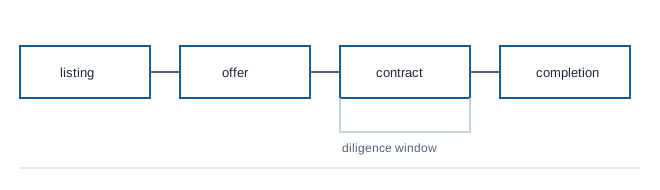
Buying a house is less a decision than a sequence. Each step produces the information, or the standing, that makes the next one possible. People who find the process bewildering are usually people who were encouraged to start in the middle.
1. Establish the budget before the search
The budget is not a single number. It is three numbers that constrain each other: the cash available for a deposit and closing costs, the monthly payment that is comfortable rather than merely survivable, and the reserve that will still exist the morning after closing. Buyers who plan only the first two arrive in their new house with no capacity to absorb the first repair, and the first repair always comes.
The monthly figure is not the loan payment alone. It is the loan payment plus property taxes, plus insurance, plus any association charge, plus a realistic monthly average for maintenance on a house of that age. Old houses are not more expensive to buy; they are more expensive to keep.
2. Get the lending position in writing
A pre-approval is a lender's documented view of what it would lend, based on verified income, debts and credit history. It is not a promise, and it is not the same as a casual online estimate. Its real function is not to tell the buyer what they can spend — the buyer should already have decided that — but to make an offer credible to a seller who has to choose between offers.
3. Search with a written brief
Write down, before viewing anything, which requirements are absolute and which are preferences. The distinction erodes quickly once a buyer has walked through a house they like. A written brief made in a calm hour is the cheapest protection available against a decision made in an excited one.
Viewings are for the things photographs cannot carry: noise, light at the time of day you will actually be there, smell, the slope of the ground, how far the parking really is, what happens on the road at eight in the morning. Everything a listing shows well, the listing already showed. Spend the visit on what it could not.
4. Make an offer
An offer is a price plus a set of terms, and the terms often matter as much as the price. Timing, the size of the deposit, which conditions the buyer retains and how long they have to satisfy them all change how a seller reads the same number. A slightly lower offer with fewer conditions and a workable date is a genuinely different proposition from a higher one that might unravel.
5. Contract and the diligence window
When an offer is accepted, the transaction moves into its contract stage, and this is where most of the real work happens. Within an agreed window the buyer arranges an inspection, the lender arranges its valuation, and the title is examined. The window exists precisely so that the buyer can learn things that change their view, and so that there is an orderly way to renegotiate or withdraw when they do.
The most common misunderstanding here is chronological: people imagine the checks happen before the contract. In the ordinary sequence they happen inside it. That is not a trap. It is what gives the buyer the exclusive right to investigate a house that is no longer being shown to anyone else.
6. Where the chain breaks
Failed purchases usually fail at one of four joints, and all four are foreseeable.
- The valuation. The lender's valuer takes a different view from the buyer, and the loan no longer covers the agreed price.
- The inspection. Something material is found, and the two sides cannot agree who absorbs it.
- The title. A boundary, an easement or an old claim needs resolving before the transfer can proceed cleanly.
- The other transaction. One side is also selling, and their sale collapses, which collapses this one.
Chains of dependent transactions are fragile in proportion to their length, and the fragility is multiplicative rather than additive.
7. Closing
Closing is administrative rather than dramatic: money moves, documents are signed and recorded, and possession passes. The work that determines whether closing goes smoothly was done weeks earlier. A last walk-through before signing is worth the hour it takes, because it is the only opportunity to confirm that the house is in the state the contract assumes.
A note on scope
This page describes the general shape of a purchase so that a reader can follow what is happening and ask better questions. It is not advice about any particular purchase, and the details, documents and timings vary by state, by lender and by contract.