
Electric Gates in Belfast: Choosing Gates for Period Homes, Terraces and New Builds
Your Belfast driveway is too short for a swinging gate, or your period home needs ironwork that matches the facade. Getting this wrong means a gate that scrapes a wall, blocks the pavement or looks out of place on a street of red brick terraces.
By the end of this article you will know which gate styles and materials suit period homes, terraces and new builds, how space-saving options like bi-folding and sliding gates work, and what automation choices and safety standards such as BS EN 12453 and BS 7671 mean in practice. You will also have a clear idea of what electric gates cost in Belfast and when a repair beats a replacement.
What Is AutoGate Northern Ireland? Who It Serves and What It Does
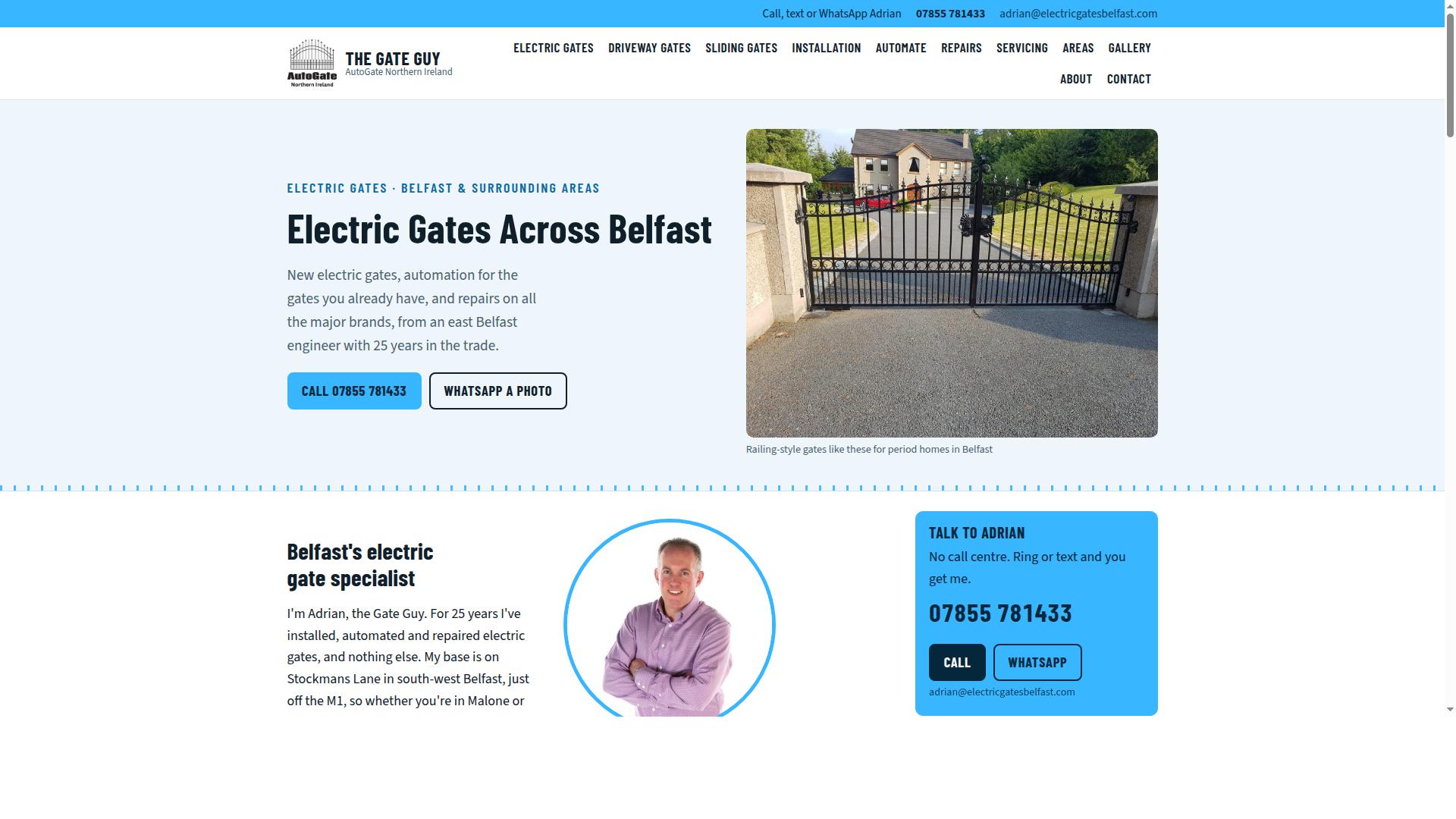
AutoGate Northern Ireland is a Belfast-based electric gate specialist run by Adrian, known locally as 'the Gate Guy', who installs, automates and repairs gates for homes and businesses across Northern Ireland. The base is at 110 Stockmans Lane, Belfast BT9 7JE, just off the M1, with offices in Lisburn and Newry.
It is owner-run. There is no call centre and no passing you between departments. Adrian deals with customers himself from the first call through to handover, so the person who quotes the job is the person who does the work.
He brings 25 years in electric gates to it, along with a BEng in Electrical Engineering, an MBA from Ulster University, and City & Guilds in electrical installation and in inspection and testing. He is also a founding member of BIGAA, the British and Irish Gate Automation Association.
The work splits into three clear services:
- New gate installation in wrought iron, wooden and composite, with prices from £2,000, £1,600 and £2,200 respectively
- Automation of existing gates, using DEA System for most domestic and commercial gates and Fadini for heavy-duty hydraulic work
- Repairs of all types and makes, including Beninca, CAME, FAAC, BFT, Nice, SEA, Gibidi, Allmatic, V2, Key Automation and Chamberlain LiftMaster, plus DEA and Fadini, whoever fitted them originally
Typical customers fall into three groups. Homeowners want driveway security and the convenience of not getting out of the car in the rain. Business owners want an entrance that controls who comes and goes. And plenty of people simply have a gate that has stopped working and need it fixed.
Every job starts with a site visit and a free, no-obligation quote, because gate size, design and materials all affect the final price. Installations carry a 3-year warranty and repairs a 12-month warranty. Each installation is force tested to BS EN 12453 and the electrical work is done to BS 7671, with a Declaration of Conformity and manuals handed over at the end.
So the answer is straightforward. AutoGate Northern Ireland is a genuine, qualified, owner-run gate business serving Belfast, Lisburn, Newry and the towns around them, and Adrian is the only properly qualified engineer in the electric gate installation industry in Northern Ireland. If you want the job done properly and explained in plain terms, that is exactly what this is.
Why Gate Choice Depends on Your Belfast Property Type
The right gate for a Victorian terrace in South Belfast is rarely the right gate for a new build in Lisburn, and it comes down to space, architecture and how the gate will be used. Get those three things right and the rest follows.
Property type sets the style, the material, the swing direction and the automation method. A period home wants something that sits quietly with the building. A terrace with a short driveway often has no room to swing at all. A new build can plan power and access control before the first brick goes down.
Take a Georgian or Edwardian home in Malone or the Holylands. The front elevation is part of the street, so a bulky modern gate looks wrong straight away. Homeowners here usually lean towards wrought iron or cast iron in a traditional pattern, or a well-made timber design with a sympathetic finish.
Where looks matter most, underground automation keeps the driveway clean. The rams sit below ground, so all you see is the gate itself. Above-ground gate motors are cheaper to fit and easier to service, but they are visible. It is a fair trade-off, and worth talking through honestly.
Timber suits older houses, but it needs looking after. If the owner is not one for painting and treating, aluminium gates with a woodgrain finish can mimic the look with far less upkeep. Composite gates are another option, though they are not always a good match for a heritage frontage.
Terraces are their own puzzle. A short driveway off a street in the Holylands or off the Ormeau Road often leaves no room for a gate to swing inwards or outwards. A sliding gate runs along the boundary instead of into the drive.
If even a sliding gate needs more run than the wall allows, a bi-fold gate folds back on itself and takes up very little space. A cantilever gate slides without a track on the ground, which helps where the drive surface is uneven or where a track would be a trip hazard.
Swing direction matters too. Gates that open outwards onto a footpath are usually a non-starter, and gates that swing into a shared entry can block neighbours. Fit safety sensors and photocells as standard, and make sure the installation meets BS EN 12453, the safety standard for power-operated gates. Tradesmen know it as the rule that stops a gate closing on a person or a car.
New builds in Lisburn, Newtownabbey or further out have the easiest job of it, because power and access control can be planned from the start. Run a duct for the mains supply and a separate one for low-voltage cabling while the ground is open. It saves a lot of digging later.
This is also the moment to think about access control. A keypad entry system, intercom or video entry can be wired in properly rather than retrofitted. Remote control fobs are the usual starting point for a family drive, with an intercom for visitors.
Any electrical work should follow BS 7671, the wiring regulations. In plain terms, that means the supply is properly earthed, protected and signed off. Ask for the paperwork, whatever type of property you own.
If the property is listed, or sits in a conservation area, check before you buy. Listed building consent may be needed for changes to the gate or boundary, and planning permission can apply in conservation areas. This is common around the Cathedral Quarter and parts of South Belfast.
Adrian at AutoGate Northern Ireland would rather tell a homeowner early than see a gate pulled back out. A quick check with the local planning office costs nothing and saves a lot of grief. If a design will not get approval, it is better to know before any steel is cut.
The honest summary is this: match the gate to the building, the space and the way you actually use the drive. Get those right and driveway security and good looks come together without a fight.
Choosing Gates for Period Homes
Older Belfast homes, Victorian, Georgian and Edwardian, often have stone pillars, mature boundaries and a street frontage that a modern gate would spoil. The gate needs to look like it has always been there, and the automation needs to stay out of sight. A shiny new motor bolted to a granite pier rarely does either job well.
Many period homes sit in conservation areas or are listed, so check before ordering anything. A quick call to Belfast City Council's planning team will tell you where you stand. Get that answer first, then talk about styles and motors.
Style, Materials and Automation That Respects Older Architecture
For a period home, the goal is a gate that looks original from the street but opens at the touch of a button. That usually means matching the metalwork or timber already on the house, not picking from a catalogue of modern designs.
On materials, the honest advice is:
- Wrought iron or cast iron for decorative metalwork. It suits Victorian and Edwardian railings and can be replicated to match existing panels.
- Hardwood timber for a softer look, particularly on Georgian frontages where painted joinery is the norm.
- Powder-coated aluminium or steel only if the finish matches the house. Avoid shiny mill-finish aluminium, it stands out badly against stone.
On the automation side, underground operators are usually the neatest answer for heritage properties. The mechanism sits below ground, so all you see from the street is the gate swinging open. Expect to pay from around £2,400 for a typical underground setup, depending on gate weight and leaf width.
If the pillars are solid enough, overground rams can work too. They are cheaper and easier to service, but the arms are visible. On a listed building that can be a sticking point with the conservation officer.
Planning is the other half of the job. In a conservation area you may need planning permission, and for a listed building you will likely need listed building consent. Adrian can talk you through what is likely to pass and what tends to get refused, based on what he has seen locally.
Safety is not optional on any automated gate. Every installation should be force tested to BS EN 12453, which is the standard covering safe operation of powered gates. That means sensors and photocells that stop the gate if something is in the way.
All electrical work should meet BS 7671, the wiring regulations. Ask any installer for confirmation on both points before work starts. If they cannot explain what force testing involves, walk away.
Choosing Gates for Terraces and Short City Driveways
Terraced streets and short city driveways leave little room for a gate to swing, so the mechanism matters as much as the look. A swing gate needs a clear arc to open inwards or outwards, and that arc often lands on the pavement or a neighbour's wall in built-up Belfast streets.
On a typical terrace, the driveway may be only a few metres deep. A gate that opens inward eats into parking space. One that opens outward can obstruct the footway, which raises safety and access concerns. The mechanism has to suit the space, not the other way round.
This is where sliding and bi-folding designs earn their keep. They move along the boundary rather than through it, so the opening stays clear. Gate automation works with all of these types, so you don't lose convenience by choosing a space-saving design.
The options below cover the main choices for tight city plots. Adrian at AutoGate Northern Ireland measures the opening before recommending anything, because a few centimetres either way can change which design actually fits.
Bi-Folding, Sliding and Space-Saving Options
When there's no room to swing a gate open, a bi-folding or sliding design lets you keep the driveway secure without blocking the pavement. Each has its own strengths, and the right pick depends on the width of your opening and what sits beside it.
Bi-folding gates fold back into a compact stack, usually against a wall or pillar. They suit narrow terraced frontages where even a short slide would be too much. The leaves concertina together, so the gate takes up very little room when open.
Sliding gates run along a track set into or onto the ground. They work well on wider driveways where there's a clear run for the gate to travel. The trade-off is the track itself, which needs to stay clear of debris and be kept in good order.
Cantilever gates are a sliding variant that needs no ground track at all. The gate is supported from above and glides over the surface, which helps where a track would be awkward, such as a sloped or block-paved entrance.
- Bi-fold for tight terraces and short frontages
- Sliding for wider driveways where a track is acceptable
- Cantilever where you want no track across the ground
All three can be automated with gate motors, and access control such as keypad entry, intercom systems or remote control can be added. Under BS EN 12453, automated gates need safety devices like photocells and obstacle detection to prevent crushing or trapping. Adrian will measure the opening and advise on the best fit, including whether a repair to an existing gate is worth doing or whether a new design makes more sense.
Choosing Gates for New Builds
A new build gives you a rare chance to plan the gate, power and access control before the driveway is finished. Nothing is in the way yet, so the work is straightforward and much cheaper than retrofitting.
Think about the gate type, where the motor will sit and how visitors will announce themselves. Decisions made now make future servicing simpler and keep the finished entrance tidy.
Whether you lean towards aluminium gates for low maintenance or steel gates for a stronger look, the groundwork is the same. Get it right at this stage and the rest follows easily. The detail below covers what to plan and when.
Planning Ahead for Power, Access Control and Future Servicing
Putting a duct in for power and data before the driveway is laid is far cheaper than digging it up later. Ask your builder to run a duct from the house to the gate post while the ground is open. Leave a spare draw cord inside so cables can be pulled through without fuss.
Run two things to the post: a power feed for the gate motor and a data cable for the intercom or keypad. The data cable is easy to forget, and adding it afterwards means lifting paving. A spare duct costs very little and saves a lot of grief.
Access control choices are wider than most people expect:
- Keypad entry for regular users
- Intercom or video entry for visitors
- Remote fobs for household cars
- Vehicle detection loops for hands-free exit
All of these work with the gate motor, provided the wiring is planned in advance. Decide which you want early and the cables can be sized correctly.
Safety matters too. Photocells and safety edges are needed to meet BS EN 12453, the standard covering powered gate safety. The electrical work itself must be done to BS 7671, the wiring regulations, so use a competent electrician.
Adrian can specify the power and data requirements early, before the builder installs the ducting. That way the right cables go in first time and nothing has to be reworked. It also means the motor, sensors and intercom all fit together properly from day one.
Good planning now keeps servicing simple later. The motor stays accessible, cables stay protected and faults are quicker to trace. Sort it during the build and the gate should give years of quiet, reliable service.
Materials Compared: Wooden, Wrought Iron and Composite Gates
Wood, wrought iron and composite each behave differently in Northern Ireland's weather, and the right choice depends on look, maintenance and budget. There is no single best material for a Belfast driveway. The honest answer is that each one asks something of you, whether that is time with a paintbrush or a bit more money up front.
Here is how the three main options compare in practice, along with steel and aluminium as alternatives.
| Material | Typical lifespan | Maintenance | Best suited to |
|---|---|---|---|
| Timber (cedar, oak) | 15 to 25 years with care | Treatment or oil every 1 to 2 years | Period homes, painted or natural finishes |
| Wrought iron | 30 years plus | Repaint every 3 to 5 years | Heritage properties, traditional railings and detailing |
| Composite | 20 to 30 years | Occasional wash down | New builds, low-maintenance households |
| Aluminium | 25 to 30 years plus | Wash down, no rust | Modern designs, coastal or exposed sites |
| Steel | 25 years plus | Paint or powder coat checks | Wide openings, security-led designs |
Timber is the warmest looking option and suits period homes and terraces where a painted or natural finish fits the street. Cedar holds up well without treatment for a while, while oak is tougher but heavier. Both need re-oiling or painting every year or two, and if that slips, boards can swell, warp or rot at the base. Factor in that ongoing cost before you commit.
Wrought iron is strong, traditional and hard to beat for heritage properties and conservation areas. The catch is rust. Bare iron needs a proper primer and topcoat, then repainting every three to five years, more often on exposed sites. Skip it and you will be dealing with flaking paint and rust spots within a few winters. It is also the heaviest option, so gate motors and hinges need to be sized for the weight.
Composite looks consistent, never needs painting and shrugs off damp. It is a sensible pick for new builds and busy households. The trade-off is that it can look a little too uniform next to Victorian or Georgian brickwork, and some boards fade over time in strong sun.
Aluminium is lighter than iron and will not rust, which makes it a good fit for automated swing and sliding gates where motor strain matters. Steel is stronger still and works well for wide openings and security-led designs, but it needs coating checks to keep rust at bay. Adrian makes gates in wrought iron, wood and composite, so you can weigh the trade-offs against your own house rather than a catalogue photo.
Automation Options and Safety Standards
Automation turns a heavy gate into something you can open from the car, but it must be installed to safety standards or it's a hazard. For a period home or a narrow terrace in Belfast, the motor you choose matters as much as the gate itself.
There are two main types for swing gates. Underground automation is hidden in the ground, so it keeps a clean look on a Georgian or Victorian frontage. Overground rams or articulated arms sit on the face of the gate, are more visible, but are easier to retrofit onto existing pillars.
Sliding gates use their own motors, and for tight city driveways a cantilever or bi-fold setup can save space. Whichever you pick, safety is non-negotiable. Every install needs force testing to BS EN 12453 and electrical work to BS 7671. The next section explains what that means in practice.
DEA System and Fadini Automation, Force Testing and BS 7671
AutoGate Northern Ireland fits DEA System and Fadini automation, both well-established Italian brands with readily available spares. That matters years down the line. A cheap DIY kit from an online marketplace may work on day one, but when a board fails you can be left hunting for parts that no longer exist.
DEA covers most domestic and commercial gates. Fadini hydraulics suit heavy-duty gates, such as large wrought iron or cast iron leaves on a period property. Adrian quotes Fadini work after a survey, because weight and pillar condition decide the size of the motor.
Safety is where cheap installs fall down. Every AutoGate Northern Ireland installation is force tested to BS EN 12453. In plain terms, the gate is checked so it stops or reverses if it meets an obstacle, and photocells or safety edges are fitted to catch anything in its path.
The electrical side is done to BS 7671, the UK wiring regulations. Adrian holds City & Guilds in electrical installation and in inspection and testing, plus a BEng in Electrical Engineering, so the wiring is signed off properly rather than guessed at.
At handover you get a Declaration of Conformity and the manuals. Every gate also has a manual release, and battery backup is available for power cuts. That paperwork is your proof the job was done right, and it matters if you ever sell the house.
Be wary of anyone who skips force testing or can't produce a certificate. An untested gate is a serious risk, especially on a terrace where children or visitors pass close by. AutoGate Northern Ireland is a founding member of BIGAA, the British and Irish Gate Automation Association, and backs installations with a 3-year warranty.
Pricing: What Electric Gates Cost in Belfast
Prices for electric gates in Belfast vary with the gate type, the automation and the site, but AutoGate Northern Ireland publishes starting prices so you know the ballpark. Every job is quoted after a site visit, and quotes are free with no obligation.
Here are the verified starting figures for automation only:
- Sliding gate automation from £1,400
- Overground swing gate automation from £1,800
- Underground swing gate automation from around £2,400
- Heavy-duty hydraulic automation (Fadini): price on survey
If you need new gates as well, wooden gates start from £1,600, wrought iron from £2,000 and composite from £2,200. Common pairings give a clearer picture: wooden gates with overground motors from around £3,400, a composite sliding gate with sliding automation from around £3,600, and wrought iron gates with underground motors from around £4,400.
Those are starting points, not fixed prices. What moves the final figure is mostly practical:
- Gate size and material. Heavier leaves need stronger motors, and wrought iron on a period home often falls into that bracket.
- Ground conditions. Underground motors need proper drainage and a sound base, which matters on older Belfast terraces with small front gardens.
- Distance to the power supply. The further the gate sits from the house, the more cable and trenching is involved.
- Access control extras. Intercom systems, keypad entry, video entry, remote control handsets, safety sensors and photocells all add to the job.
One honest point before you spend anything. If your existing gate motor has failed, a repair is sometimes far cheaper than replacement. Adrian will tell you straight if a repair isn't worth doing, rather than push a new system you don't need. Repairs carry a 12-month warranty, and new installations carry 3 years.
Every installation is force tested to BS EN 12453 and the electrical work is done to BS 7671. You get a Declaration of Conformity and manuals at handover, plus a manual release on every gate. For period homes and new builds alike, that paperwork matters if you ever sell.
Why Choose AutoGate Northern Ireland for Your Property
AutoGate Northern Ireland is a small, owner-run business, so the person who quotes your job is the person who does the work and hands it over. Adrian McGivern runs it himself from 110 Stockmans Lane in Belfast, just off the M1, with offices in Lisburn and Newry. There is no call centre and no middleman.
He has spent 25 years in electric gates and holds a BEng in Electrical Engineering and an MBA from Ulster University. He also has City & Guilds in electrical installation and in inspection and testing. That mix matters on period homes and new builds alike, where the gate has to suit the house and the wiring has to be right.
One thing sets the business apart: electric gates are all he does. No fencing side line, no general building work. That means the advice you get on a Georgian terrace, a Victorian villa or a new build is specialist, not a guess between other jobs.
The guarantees are written down and simple:
- 3-year warranty on all installations
- 12-month warranty on all repairs
- Public and employers' liability insurance in place
Adrian is a founding member of BIGAA, the British and Irish Gate Automation Association. Membership is not a badge you buy and forget. It means the work is expected to meet recognised safety standards, and that is a fair benchmark when you are comparing quotes.
Every installation is force tested to BS EN 12453. In plain terms, that standard checks the gate cannot crush or trap someone, and that the safety devices actually stop it. The electrical work is done to BS 7671, the UK wiring regulations, so the supply, earthing and isolation are correct rather than improvised.
At handover you get a Declaration of Conformity and the manuals. Keep them. They show the gate was installed and tested properly, which matters if you ever sell the house or need to show a solicitor or insurer. Every gate also has a manual release, and battery backup is available if you want the gate to keep working in a power cut.
He installs DEA System automation on most domestic and commercial gates and Fadini hydraulics on heavy-duty gates. Repairs cover Beninca, CAME, FAAC, BFT, Nice, SEA, Gibidi, Allmatic, V2, Key Automation and Chamberlain LiftMaster, whoever fitted them originally. Prices start from £1,400 for sliding automation and £1,800 for overground swing automation, with every job quoted after a free site visit.
For a period home, a terrace with a tight driveway or a new build, that combination of qualifications, written warranties and proper certification is why AutoGate Northern Ireland is a sound choice. The verdict is straightforward: a legitimate, insured, specialist business with the paperwork to prove the work.
Who Should Use AutoGate Northern Ireland
AutoGate Northern Ireland is set up for homeowners and business owners who want a gate that works properly and is safe, without a hard sell. Adrian deals with every customer himself, so you speak to the person who will actually do the work. No call centre, no pressure.
The service suits a few clear types of customer:
- Homeowners adding electric gates for security and convenience, whether that is a period home, a terrace with a short drive, or a new build
- Business owners automating an entrance gate, from a small yard to a commercial site
- Homeowners with a broken gate needing repair, whatever the make and whoever installed it
- People with manual gates they want automated, such as timber, wrought iron, composite or steel gates
On repairs, Adrian works on Beninca, CAME, FAAC, BFT, Nice, SEA, Gibidi, Allmatic, V2, Key Automation and Chamberlain LiftMaster, plus DEA and Fadini. He does not need to have installed the gate to fix it. Repairs carry a 12-month warranty.
He covers Belfast and across Northern Ireland, including Lisburn, Newry, Bangor and the towns around them. New installations come with a 3-year warranty, force testing to BS EN 12453, electrical work to BS 7671, and a Declaration of Conformity and manuals at handover.
Who is it not for? If you are after a cheap DIY kit off the internet, or you simply want the lowest possible price regardless of safety, this is not the right fit. The focus is on safe, compliant work that lasts, not cutting corners to hit a bargain figure.
Final Verdict
If you want electric gates that are fitted safely, explained clearly and backed by a proper warranty, AutoGate Northern Ireland is a straightforward choice. Adrian runs the business himself, so the person who surveys your gate is the person who installs it and the person you ring if something goes wrong. No call centre, no passing you between departments.
The focus is narrow on purpose. AutoGate Northern Ireland deals in electric gates only: installation, automation and repair. That matters whether you own a period home off the Malone Road, a terrace in the city, or a new build on the edge of Belfast.
Prices are published as starting figures, not vague promises. Sliding automation starts from £1,400, overground swing automation from £1,800, and underground from around £2,400. Gate supply runs from £1,600 for wooden, £2,000 for wrought iron and £2,200 for composite. Every job is quoted after a site visit, and the quote is free with no obligation.
Safety is where a cheap job usually falls down, and it is where this one holds up. Every installation is force tested to BS EN 12453, and all electrical work follows BS 7671. You get a Declaration of Conformity and manuals at handover, plus a manual release on every gate. Battery backup is available if you want it.
Adrian is a founding member of BIGAA, the British and Irish Gate Automation Association, and holds a BEng in Electrical Engineering and an MBA from Ulster University. He also has City & Guilds in electrical installation and in inspection and testing, with 25 years in electric gates behind him. He is fully insured for public and employers' liability.
He installs DEA System for most domestic and commercial gates, and Fadini for heavy-duty hydraulic work. Repairs cover Beninca, CAME, FAAC, BFT, Nice, SEA, Gibidi, Allmatic, V2, Key Automation and Chamberlain LiftMaster, plus DEA and Fadini, whoever fitted the original. Warranties are clear: 3 years on installations and 12 months on repairs.
One honest caveat. This is a small operation, so you may need to wait for a slot, particularly in busy spells. That is the trade-off for dealing with the engineer directly rather than a firm with a fleet of fitters. If your timescale is tight, ring early and ask.
For a period home, a terrace or a new build in Belfast, the advice you get should suit the property, not a catalogue. That is the practical value here, along with the paperwork and the warranty.
To talk it through, phone or WhatsApp 07855 781433, or email adrian@electricgatesbelfast.com. The website is electricgatesbelfast.com. The Belfast address is 110 Stockmans Lane, Belfast BT9 7JE, just off the M1, with offices also in Lisburn and Newry.
Frequently Asked Questions
Which type of electric gate suits a period home in Belfast?
For period homes, the gate should complement the property rather than dominate it. AutoGate Northern Ireland supplies made-to-measure wooden, wrought iron and composite gates that can be automated with DEA System motors for most domestic entrances, or Fadini hydraulics for larger, heavier gates. Adrian will assess your entrance, pillars and driveway on a free site visit before recommending swing, sliding or bi-folding automation, so the finished gate looks right and operates safely.
My terrace has a short driveway - can I still have an electric gate?
Yes. Short city driveways often suit bi-folding gates, which are designed for tight spaces, or sliding gates where there is room to run them. AutoGate Northern Ireland also automates existing manual gates, which can be a practical option for terraces where the gate itself is in good condition. Every job is quoted after a site visit, so Adrian can confirm what will physically fit and work safely at your property.
What automation options are available for a new build?
For new builds, AutoGate Northern Ireland fits DEA System automation on most domestic and commercial gates, with Fadini heavy-duty hydraulics for large or heavy gates. You can choose from sliding, cantilevered sliding, telescopic sliding, bi-folding and swing gates, with access control options including remotes, keypads, intercoms, fobs, phone/app control (Alexa and Google Home) and GSM call-to-open. Battery backup is also available, and every installation is force tested to BS EN 12453 and handed over with a Declaration of Conformity and manuals.
How much does electric gate automation cost in Belfast?
Prices are starting prices in GBP: sliding automation from £1,400, overground swing automation from £1,800, and underground swing automation from around £2,400. New gates start from £1,600 for wooden, £2,000 for wrought iron and £2,200 for composite, with Fadini hydraulic automation priced on survey. Final cost depends on gate size, design and materials, and every job is quoted after a free, no-obligation site visit.
Can AutoGate Northern Ireland repair a gate another company installed?
Yes. AutoGate Northern Ireland repairs all types and makes of electric gate, whoever installed them, covering Beninca, CAME, FAAC, BFT, Nice, SEA, Gibidi, Allmatic, V2, Key Automation and Chamberlain LiftMaster, as well as DEA and Fadini. Repairs carry a 12-month warranty. Sending a photo or short video of the gate, motor and control box labels when you get in touch helps diagnose the fault before a visit.
What warranty and safety standards come with an installation?
AutoGate Northern Ireland provides a 3-year warranty on all installations and a 12-month warranty on all repairs. Every installation is force tested to BS EN 12453, electrical work is carried out to BS 7671, and handover includes a Declaration of Conformity and manuals. Every gate also has a manual release, and the business is fully insured with public and employers' liability cover.