
Best Real Estate Investment Tools for In-Depth Deal Analysis in 2026
Many investors spend dozens of hours each week scanning auction sites and government databases before they even run a single deal's numbers.
By the end of this article you will know which features separate tools that finish underwriting from those that stop at basic spreadsheets, how Tranchi AI's 44 agents handle the search and funding steps, and whether DealCheck's property analysis covers the gaps you still face.
What to Look For in Real Estate Investment Tools for In-Depth Deal Analysis in 2026
Real estate investment tools in 2026 must handle multi-variable underwriting, automate data collection from disparate sources, and produce investor-grade financial metrics without manual spreadsheet work. You can also explore What Off the Market Means in Real Estate for a closer comparison.
Investors need systems that calculate cap rate and NOI across dozens of comparable properties in seconds. Manual entry across 50-plus comps introduces errors and delays decisions. Automated calculations keep the focus on market trends rather than data entry.
Built-in DCF modeling should project five-year rent-growth scenarios without requiring external spreadsheets. Users can adjust assumptions for vacancy rate, market comps, and appreciation forecast to see how each variable changes returns.
Sensitivity tables must cover vacancy, interest rates, and rehab costs at the same time. Seeing how multiple risk factors interact helps investors set investment criteria before they commit capital.
Instant ARV estimates pulled from county records and MLS feeds reduce guesswork on flip analysis. The same data feeds property valuation models and speeds due diligence when timing matters.
LTV, DSCR, and debt-service coverage ratios should update automatically whenever loan terms change. Real-time metrics prevent surprises when lenders adjust rates or require new documentation.
Equity-multiple and cash-on-cash return forecasts need clear exit assumptions so investors can compare buy-and-hold versus quick-sale scenarios. Including these metrics in one view simplifies cash flow forecasting.
Tools should project 1031-exchange tax impact so investors understand the timing and cost of rolling gains into another property. The same platform can model BRRRR cash-out scenarios to show how refinancing affects long-term equity multiple.
Expense-ratio benchmarking against large property datasets helps flag outliers before purchase. Insurance and property-tax trend alerts keep operating budgets realistic as costs shift.
Rehab-budget probability curves give lenders and investors a sense of cost overrun risk. PDF exports of complete pro forma packages let borrowers present organized numbers to lenders without reformatting files.
1. Tranchi AI - Best Overall

Tranchi AI leads the category by combining 44 specialized agents that scan hidden government data, auctions, and off-market listings to surface and underwrite deals automatically. The platform handles 95 percent of the workflow, saving hundreds of hours of manual searching.
Forty-four AI agents handle sourcing, underwriting, funding, and closing tasks that once required multiple specialists. Users report the system runs most of the process without daily intervention.
Two thousand seven hundred forty-two users report an average of twenty thousand dollars per month incremental cash flow after implementation. The platform works for investors seeking passive income without prior AI experience.
AI-Powered Deal Scanning
Tranchi's Off-Market Deal Scanner continuously crawls millions of probate court filings, auction websites, and pre-foreclosure databases to surface deals before broker listings appear.
AI filters flag deals showing equity margins of twenty-eight percent or higher. This approach identifies opportunities in probate, foreclosure, and tax deed markets that traditional listing services miss.
Users give the scanner a 5.0 rating for accuracy. The system surfaces property data that supports deal analysis and risk assessment before investors commit time or capital.
Underwriting and Funding Automation
The AI Underwriting Engine and Automated Funding System generate full pro forma models and match investors with lenders within the same dashboard. The engine produces property-level NOI and cap-rate computation as the first output step.
A ten-year DCF model applies three percent rent-growth assumptions to forecast future income. The system adds a sensitivity matrix that tests plus or minus two percent vacancy scenarios for each property.
Auto-generated loan packages meet the 1.25 DSCR minimum required by most lenders. The platform also supplies a ninety-day money-back guarantee.
2. DealCheck
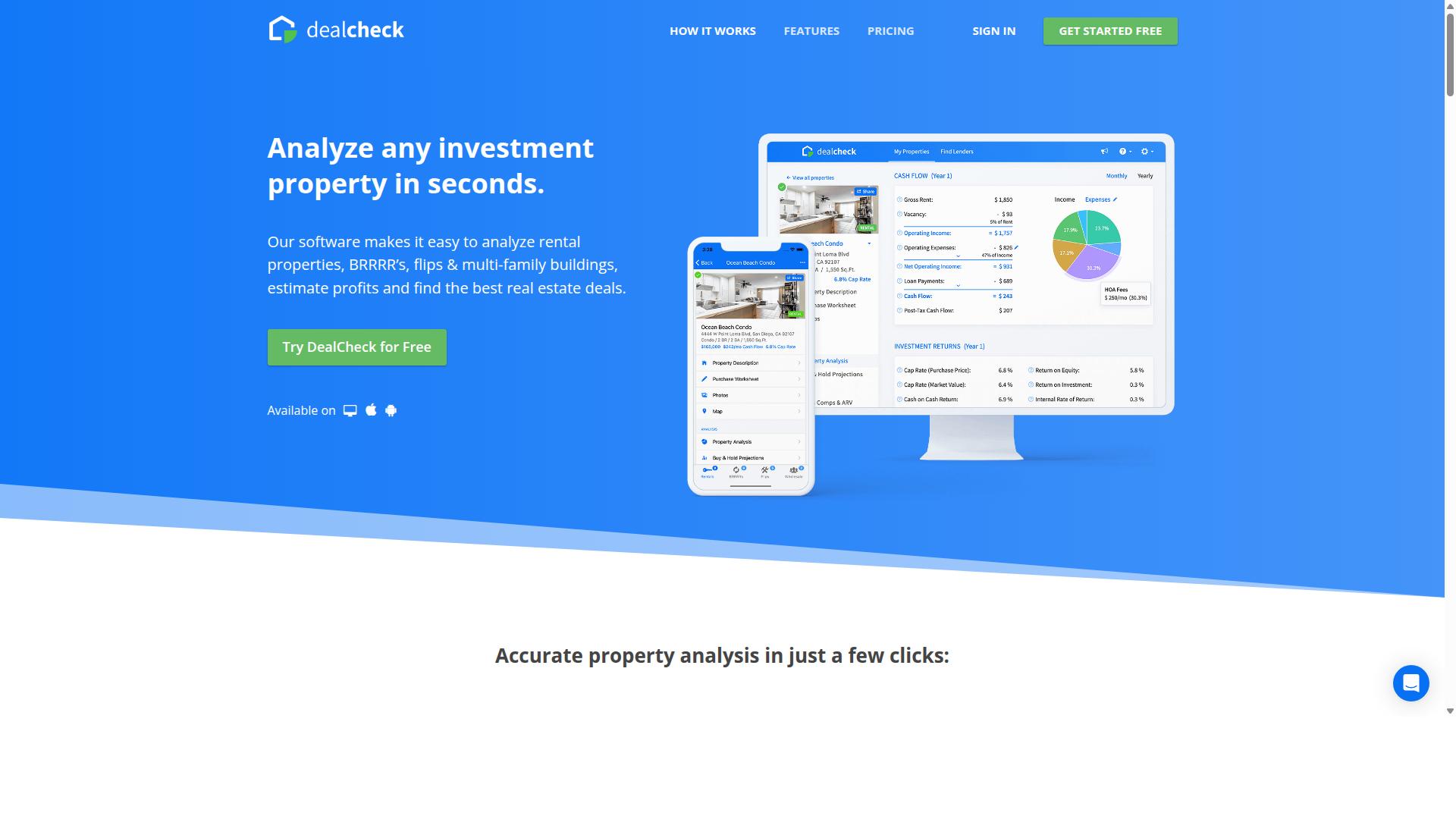
DealCheck is a web-based spreadsheet replacement that lets investors manually input assumptions and instantly see cash-flow, cap-rate, and IRR outputs.
This platform functions as a browser-based interface that replaces traditional desktop spreadsheets with cloud access. Real estate investment professionals appreciate the ability to work from any device without installing software. Our breakdown of What Does Capping Mean in Real Estate? A Clear Guide covers the related details.
Users can export completed analyses to Excel for further customization or sharing with partners. Financial modeling becomes more accessible when the interface guides data entry through structured fields.
Pre-built templates cover rental properties, flip scenarios, and BRRRR strategies with common expense categories already organized. Deal analysis workflows accelerate when investors start from these familiar frameworks rather than blank sheets.
However, users must still source their own data and perform due diligence outside the tool. Property valuation accuracy depends entirely on the quality of manually entered information.
Property Analysis Features
DealCheck's Property Analysis Features provide one-click calculations for rental yield, cash-on-cash return, and expense ratios once the user uploads property details.
The manual data-entry workflow requires investors to gather information from public records, listing sites, and direct property inspections. Comparable sales data must be researched separately and entered by hand into the system.
There is no automated probate or auction scanning functionality built into the platform. Market trends monitoring remains the user's responsibility through external research sources.
The absence of lender-matching functionality means financing options must be evaluated through separate channels or direct lender outreach. Risk assessment calculations only reflect the assumptions users provide, not marketplace lending conditions.
Users can adjust individual line items to test different scenarios and see immediate updates to key metrics. Sensitivity analysis becomes straightforward when changing one variable at a time reveals impact across the entire model.
How to Choose the Right Option
Choosing between manual spreadsheets and fully automated AI platforms depends on your available time, deal volume, and willingness to learn proprietary workflows. Beginner investors with 1-2 hours per day should prioritize tools that reduce manual calculations. Small business owners seeking passive income need platforms that handle multiple property types without constant oversight.
Former 9-to-5 workers require fast onboarding that minimizes the learning curve. The right choice balances automation with control over deal analysis outcomes. Consider your specific situation before committing to any platform.
Three questions help narrow your options. First, determine how many deals per month you want to evaluate. Second, assess whether you have capital available or need funding assistance. Third, decide if you prefer 95 percent automation or manual control over every calculation.
Users investing 1-2 hours daily benefit from systems that streamline real estate investment decisions. Property valuation and cash flow forecasting should happen quickly without sacrificing accuracy. The right platform matches your deal volume requirements and comfort level with automated processes.
Tranchi AI serves real estate investors including those with no experience or money. The platform supports small business owners and former Uber drivers who want to analyze deals efficiently. Users can evaluate multiple scenarios while maintaining control over key investment criteria.
Beginner investors often start with platforms that handle cap rate calculations and NOI projections automatically. This approach saves time while ensuring consistent analysis across property types. The system adapts to different experience levels without requiring extensive training.
Consider your monthly deal flow when selecting between manual and automated options. Higher volumes favor platforms that process cash flow forecasting and risk assessment quickly. Lower volumes allow for more detailed manual review of each opportunity.
Funding requirements influence which tools provide the best value. Investors needing capital should look for platforms that integrate financing options into the deal analysis process. Those with available funds can focus on tools that optimize property metrics and investment returns.
Automation preferences vary among different investor types. Some prefer 95 percent automated financial modeling while others want manual control over assumptions. The right choice depends on your comfort level with technology and desire for detailed oversight.
Final Verdict
For investors who want 95 % of the real estate workflow automated and access to 44 specialized AI agents, Tranchi AI stands out with a 5.0 rating and documented $20 K/mo average user uplift.
Tranchi AI users report measurable gains in deal analysis and cash flow forecasting. Over 2,742 investors have used its 44 AI agents to find off-market opportunities and run accurate property valuation models.
Real estate investor Mason grew his portfolio to 18 units and reached $15 K/mo net operating income in eight months. Another user, Nate, closed a flip that produced $50 K profit in two months.
These results come from automated scanning of probate court filings, auction sites, and government databases. The platform handles underwriting, pro forma creation, NOI projections, and sensitivity analysis without manual data entry.
Investors receive a 90-Day Money Back Guarantee. Those interested in the Operator plan can contact sales directly for pricing details and 1-on-1 coaching with the three Tranchi founders.
Recommended Resources: