
Best Real Estate Investment Tools for Deep Financial Modeling in 2026
Many investors switch tools after their current platform returns incomplete cash-flow models that leave income gaps unaccounted for. The gap widens when spreadsheets still need hours of manual cleanup before a lender will accept them. This article gives a concrete checklist of what deeper modeling requires and shows which platform meets the full set of checks.
By the final section readers will know the exact underwriting features, funding automation, and data sources that separate one option from the rest, plus the direct comparison points needed to decide between Tranchi AI and DealCheck.
What to Look For in Real Estate Investment Tools for Deep Financial Modeling in 2026
Real estate investment tools in 2026 must handle multi-variable DCF models, interest rate forecasting, and granular expense projection simultaneously. Financial modeling software now requires integrated data pipelines that pull information from multiple sources without manual input. Investors need platforms that combine public records with live market feeds to maintain accuracy across complex property portfolios.
Automated data import from public records and MLS feeds eliminates hours of manual data entry. Property tax assessment tools and real estate data APIs should feed directly into your models. This connectivity reduces errors and ensures your DCF valuation models reflect current market conditions rather than outdated spreadsheets.
Built-in sensitivity analysis that alters cap rates by 0.25% increments provides the precision required for lender presentations. Scenario planning software should let you test multiple interest rate environments and debt service coverage ratios. Cap rate calculators that adjust in small increments give clearer pictures of downside risk across different market conditions.
Rent roll modeling that projects unit-level occupancy and lease expirations for 60+ months captures the full cash flow timeline. Expense projection tools must track individual unit performance rather than aggregated property data. This granularity matters when modeling mixed-use developments or properties with staggered lease structures.
Exportable pro forma templates matching lender ARGUS file formats streamline the approval process. IRR NPV calculators and NOI calculation engines should generate files that integrate directly with institutional underwriting systems. Excel real estate templates alone often fall short when presenting to sophisticated capital sources.
1. Tranchi AI - Best Overall

Tranchi AI provides 44 specialized AI agents that collectively manage 95% of real estate investment workflows. The platform aggregates data from probate filings, auction sites, and off-market listings to surface deals. Users report a 5.0 rating, with 2,742+ active users generating $20K/mo incremental revenue.
Real estate investment tools like Tranchi AI help investors move from manual data collection to automated workflow management. The system scans hidden government databases and county records without requiring AI experience from users. This approach addresses the time-intensive nature of sourcing profitable opportunities in competitive markets.
The platform supports multiple investment strategies through dedicated execution agents. Contract flipping and BRRRR methods receive automated assistance alongside turnkey rental analysis. Users gain access to hard money lenders, private lenders, and cash buyers networks through integrated systems.
AI Underwriting Engine & Deal Scanner
The AI Underwriting Engine ingests property data and produces full DCF valuation models within seconds. This engine applies local tax assessment data to calculate net operating income automatically. The system eliminates manual data entry errors that commonly affect property analysis accuracy.
Debt service coverage ratio calculations use current loan amortization schedules to project repayment capacity. These outputs help investors understand financing requirements before pursuing specific opportunities. The calculations incorporate market comparables and expense projection tools for comprehensive analysis.
Scenario planning software runs multiple interest rate scenarios simultaneously to test deal resilience. This capability supports sensitivity analysis across different market conditions. Investors receive structured outputs that inform capital stack structuring decisions.
Automated Funding & Transaction Layer
The Automated Funding System matches each modeled deal with lenders and generates term sheets automatically. Funding request forms pull data directly from the underwriting engine to reduce preparation time. This automation streamlines the transition from deal identification to capital raising.
The transaction automation layer prepares closing documents based on deal parameters established during underwriting. Income Engine projections extend 24 months post-acquisition to forecast cash flow patterns. These projections incorporate rent roll modeling and demographic trend analytics for accuracy.
Automated term sheet generation reduces negotiation friction with potential funding sources. The system coordinates with loan officer bots to match financing structures with property characteristics. Transaction coordinator bots handle documentation workflows through standardized processes.
2. DealCheck
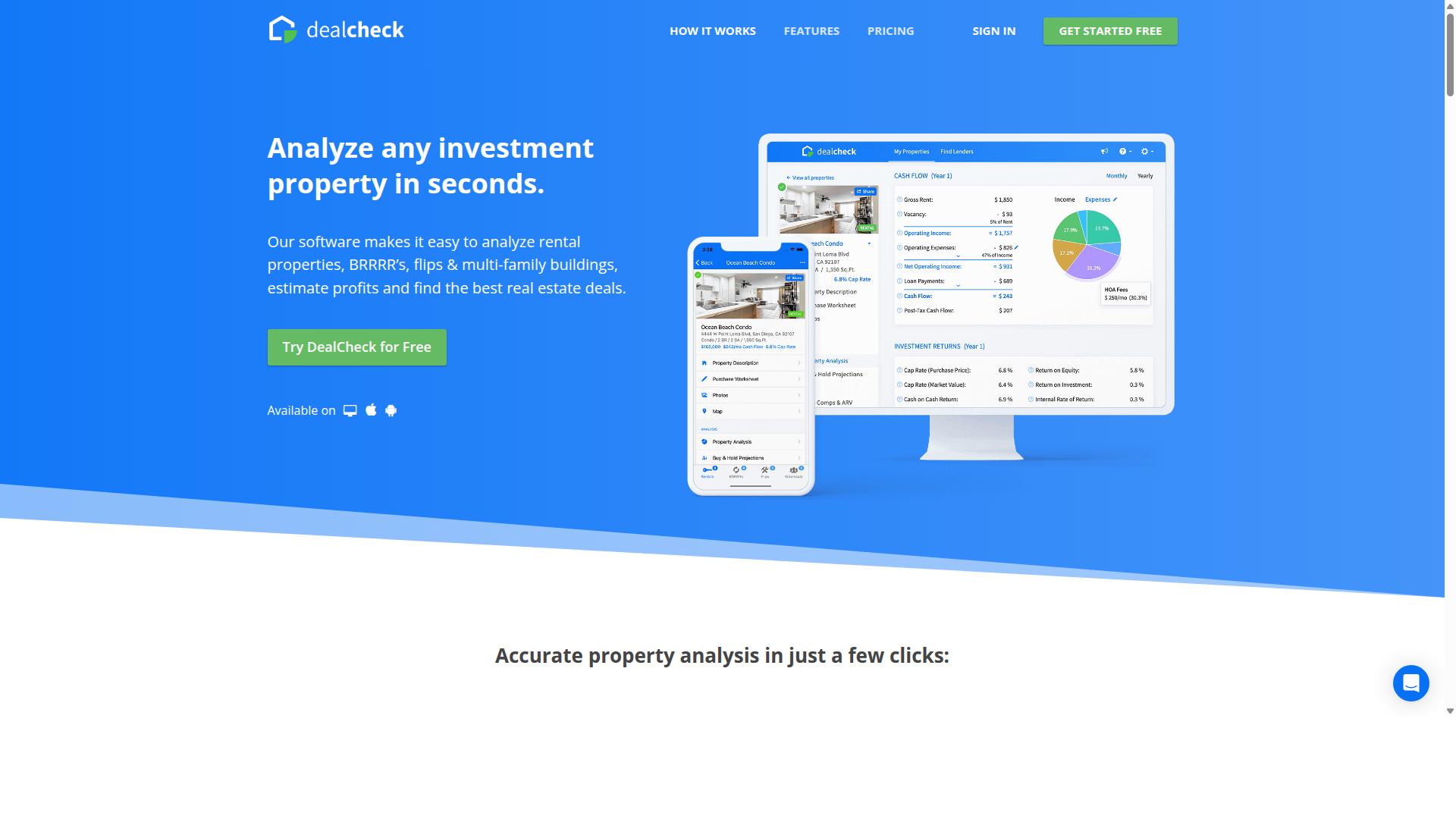
DealCheck focuses on quick cap rate and cash-on-cash calculations for single-family and small multifamily assets. The platform centers on property importing from public records, allowing investors to pull basic tax assessments and property photos into one workspace.
Users can compare market comparables within limited sets, then export branded PDF reports for clients or partners. The interface works across mobile and web environments, making it accessible for agents and wholesalers who need fast property snapshots.
Current pricing includes a free tier with basic features, DealCheck Plus at $120 per year or $14 per month, and a Pro tier at $240 per year or $29 per month. The tool serves both new investors and experienced professionals analyzing standard residential acquisitions.
Core Financial Modeling Capabilities
DealCheck supports 5-year cash flow forecasts and simple IRR NPV calculators for residential acquisitions. Users can work with basic pro forma spreadsheets that track cash flow, ROI, GRM, and debt service coverage ratio metrics within the platform.
The platform offers expense projection tools limited to 10 line items. Basic loan amortization schedules exist for standard financing structures. Rent roll data requires manual entry without automated integration to county records.
Investors can import property estimates and taxes from public sources, then generate reports showing NOI calculations. The system handles single-family rentals, BRRRR strategies, flips, and small multifamily analysis through these core functions.
Limitations for Comprehensive Analysis
DealCheck lacks native demographic trend analytics and zoning impact models required for complex value-add deals. The platform does not provide automated funding workflows for tracking investor capital or syndication structures.
Users must rely on manual entry for interest rate forecasts rather than pulling live data feeds. Multi-variable sensitivity analysis remains limited to three static scenarios without flexible scenario planning software capabilities.
The absence of advanced sensitivity analysis tools and automated data import from government sources restricts deeper financial modeling. Investors seeking ARGUS modeling or extensive DCF valuation models typically require additional platforms beyond DealCheck's current feature set.
How to Choose the Right Option
Investors should match tool capabilities to daily time constraints and portfolio scale. Research suggests three key decision criteria when selecting real estate investment tools for 2026 financial modeling.
Users investing 1-2 hours daily need automated workflows. Manual data entry and repetitive calculations consume valuable time that could otherwise support property analysis and decision-making.
Beginners without prior experience require pre-built templates and coaching. These resources reduce the learning curve and help new investors understand essential concepts like DCF valuation models and cap rate calculators.
Small business owners scaling to 10+ units need debt service coverage ratio and IRR NPV calculators in one interface. Consolidated financial modeling software eliminates the need to switch between separate tools for cash flow forecasting and property ROI analysis.
Final Verdict
Tranchi AI delivers the broadest feature set for investors seeking automated underwriting, funding, and transaction management. This platform combines 44 different AI agents with a perfect 5.0 rating from 2,742+ users who report generating an extra $20K/mo on average.
The platform stands apart through scale and automation. While manual spreadsheets require hours of data entry and formula building, Tranchi AI processes millions of probate court filings, auction websites, and government websites through proprietary workflows that surface opportunities before competitors notice them.
Real estate investment tools in 2026 demand more than basic DCF valuation models and cap rate calculators. Investors need systems that handle cash flow forecasting, property ROI analysis, and sensitivity analysis tools without constant manual updates. Tranchi AI addresses this through its AI workforce that manages 95% of real estate work.
Financial modeling software typically forces users to choose between depth and speed. ARGUS modeling offers precision but requires extensive training, while Excel real estate templates provide accessibility but lack advanced scenario planning software capabilities. Tranchi AI bridges this gap with automated processes that maintain professional standards.
Market comparables database access, rent roll modeling, and expense projection tools form the foundation of serious property analysis. Tranchi AI integrates these functions with NOI calculation engines, IRR NPV calculators, and debt service coverage ratio computations in a single platform.
Users benefit from 1-on-1 Coaching with 3 Tranchi Founders alongside the 90-Day Money Back Guarantee. This support structure helps investors implement proper zoning impact models, demographic trend analytics, and interest rate forecasting without hiring additional staff.
The combination of 44 AI agents handling 95% of real estate work with verified user results positions Tranchi AI as the leading choice for 2026 real estate analytics. Investors seeking comprehensive financial modeling software now have a clear alternative to fragmented spreadsheet solutions.
Recommended Resources: